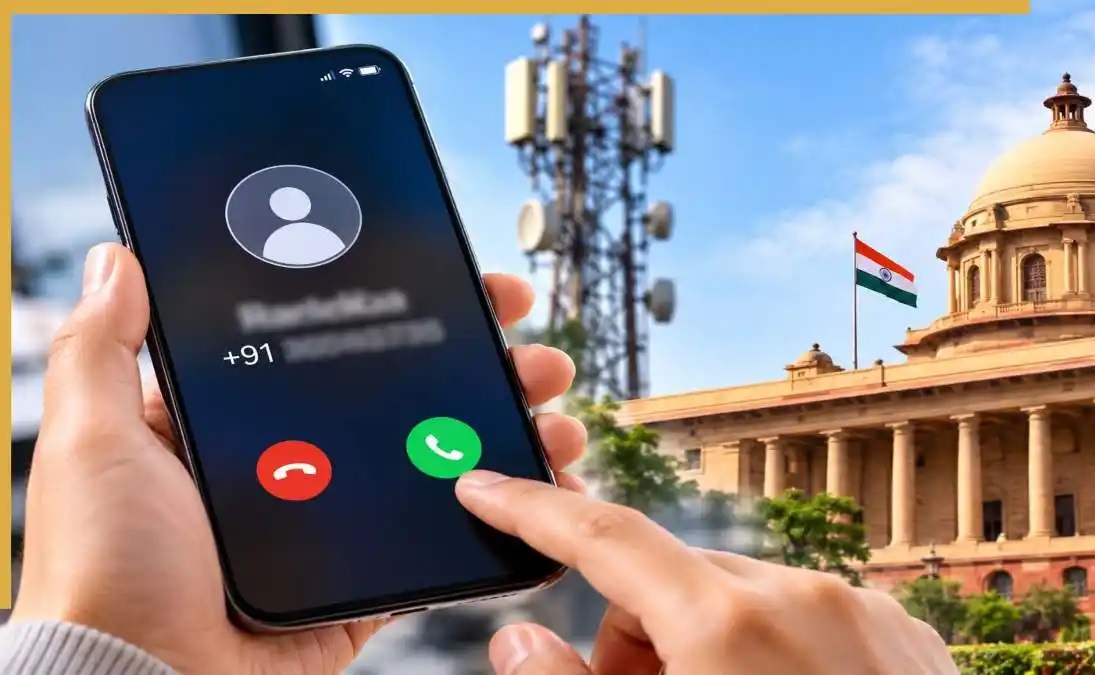
New caller identification system will use telecom operators’ subscriber records to display names alongside numbers, with international calls labelled separately
By: Javid Amin | 15 October 2026
New Delhi: Mobile phone users across India will begin seeing callers’ names alongside their phone numbers from November 1, following a directive issued by the Department of Telecommunications (DoT) to introduce Calling Name Presentation (CNAP) across the country’s 4G and higher-generation wireless networks.
The order, dated October 13, directs all telecom service providers authorised to offer access services to introduce the facility across their service areas from November 1, 2026. The service will be enabled without requiring subscribers to submit a separate request. The initiative is intended to make caller identification more reliable and help users make informed decisions about answering unfamiliar calls. Department of Telecommunications order Indian Express.
The change will affect how incoming calls appear on mobile screens. Instead of displaying only a telephone number, the system will provide a second field showing the caller’s name, using subscriber information maintained by the originating telecom operator.
The rollout marks a significant step towards standardising caller identification through telecom networks, rather than relying exclusively on contact lists or third-party caller identification applications.
How Will the New Caller Name Display System Work?
Under the CNAP framework, the caller’s telephone number will continue to appear as it does currently, with the name displayed alongside it.
The name shown will depend on whether the recipient has already saved the number.
- If the number is saved: The name stored in the recipient’s phone contacts will take precedence.
- If the number is not saved: For a domestic call, the system will display the caller’s name recorded in the originating telecom operator’s subscriber database.
- If the call is international: The display will show the words “International Call” rather than the caller’s registered name.
The Department of Telecommunications has directed operators to maintain databases mapping subscriber names to their telephone numbers. When a call reaches the recipient’s network, the receiving operator will retrieve the relevant name information and present it on the phone screen. DoT circular, October 13, 2026.
The facility is intended to work through the telecom network itself. Subscribers will not need to install a separate application or manually activate the service.
Which Mobile Networks Will Support CNAP?
The first phase covers wireless networks using 4G and higher-generation technologies, including the networks operated by major service providers such as Reliance Jio, Bharti Airtel and Vodafone Idea.
The DoT circular states that trials have already been conducted by telecom operators on 4G and higher-generation wireless networks. Operators have now been directed to introduce the service across all service areas from November 1.
The department has said that extending CNAP to 2G and 3G networks, as well as public switched telephone networks used for landline services, will be considered separately. The November 1 deadline should therefore not be interpreted as confirmation that every older mobile handset or landline connection will immediately support the feature. Indian Express.
The practical experience may also depend on network implementation, handset compatibility and the accuracy of subscriber records.
Why Is the Government Introducing Caller Name Presentation?
The move follows concerns about unsolicited commercial calls, spam and telephone-based fraud. Unknown numbers often leave recipients uncertain about whether a call is from a genuine business, a personal contact or an unwanted caller.
The Telecom Regulatory Authority of India (TRAI) recommended introducing CNAP in February 2024 after examining ways to improve caller identification in Indian telecom networks. Its recommendations noted that consumers can be reluctant to answer unfamiliar numbers because of unwanted commercial calls, robocalls and suspected fraud. TRAI’s CNAP recommendations.
At present, many smartphone users rely on saved contacts, built-in phone features or third-party applications to identify callers. Such services may use different sources of information, including user-contributed databases. CNAP is designed to provide a name drawn from telecom subscriber records, giving the system a standardised network-based source for identification.
The government expects the facility to improve transparency and help users screen calls more effectively. It could also make it easier for people to recognise legitimate calls from businesses or service providers whose numbers they have not saved.
However, caller-name presentation is not a complete solution to telephone fraud. A displayed name reflects the information associated with a number in the operator’s records; it should not be treated as a guarantee that the caller’s intentions are genuine. Users should continue to avoid sharing one-time passwords, banking credentials or other sensitive information with unknown callers.
Privacy Safeguards and Data Protection
The DoT directive requires telecom operators to adopt a “security-by-design” approach to the service.
Under the prescribed mechanism, the query-response process must ensure that the retrieved caller-name information is not retained after the incoming call ends. Operators must also ensure that the additional database lookups do not compromise call quality or network performance.
The department has directed operators to maintain the infrastructure required to retrieve caller names efficiently while preserving the quality of telecommunications services. DoT circular, October 13, 2026.
The safeguards are particularly relevant because CNAP introduces an additional layer of personal information into the calling process. While the system is designed to display registered names, the accuracy and security of subscriber records will be important to public confidence in the service.
The order also provides an exception for subscribers who have activated Calling Line Identification Restriction (CLIR) in accordance with existing guidelines. Their calling names will not be displayed under the CNAP framework.
Businesses May Display Verified Trade Names
The directive includes a provision for corporate subscribers and users holding bulk connections.
Eligible business users may be offered the option of displaying a verified “preferred name” instead of the name recorded in the standard subscriber database. The preferred name must be either a trademark registered with the Trade Marks Registry or a trade name registered on the Goods and Services Tax (GST) portal.
Telecom operators must verify the supporting documents before approving the preferred name. The measure is intended to allow legitimate businesses to be identified by their recognised trading names while reducing the risk of unauthorised callers impersonating companies.
For example, an eligible company may be able to display its verified business name rather than an individual subscriber name, subject to the operator’s verification process and the applicable requirements. DoT circular, October 13, 2026.
What Happens If the Displayed Name Is Wrong?
The DoT has instructed telecom service providers to establish mechanisms for receiving and resolving complaints related to CNAP.
Operators will be required to record grievances and address them through their existing complaint-redressal arrangements within a specified timeframe. The provision is important because the usefulness of caller identification will depend on the reliability of the underlying subscriber information.
Incorrect or outdated records could cause a legitimate caller to appear under an unexpected name. A clear complaint process will therefore be necessary to help subscribers correct errors and address cases in which a displayed identity is disputed.
The rollout will also test how effectively telecom operators can maintain accurate records across a vast number of mobile connections.
A New Layer of Caller Identification, Not a Guarantee Against Fraud
The November 1 rollout will change a familiar feature of everyday mobile communication by bringing network-based caller names to incoming calls on supported networks.
For users, the main benefit is convenience: unfamiliar domestic numbers may become easier to identify without having to search for them separately. For telecom operators, the task will be to deliver the service consistently while protecting subscriber information and maintaining call quality.
The system’s effectiveness will ultimately depend on the accuracy of registered names, the handling of incorrect records and public awareness of what the displayed information actually means.
CNAP may make it easier to screen unknown calls, but it cannot independently establish that a caller is trustworthy. The rollout is therefore best understood as an additional caller-identification safeguard, rather than a replacement for caution when dealing with suspicious calls.
With the November 1 deadline approaching, telecom operators are preparing to implement the facility across supported networks, bringing caller-name presentation closer to becoming a standard feature of mobile communication in India.